Carbon & Low Alloy Steel Casting Alloys
Carbon steel is one of the most widely used materials in investment casting, offering an exceptional combination of strength, toughness, and versatility. Its properties are primarily determined by carbon content — as carbon increases, hardness and strength improve while ductility and weldability decrease. For investment casting applications, carbon steel is broadly divided into two categories: low carbon steel and medium carbon steel, each suited to different performance requirements.
Low Carbon vs Mid Carbon Steel Casting
While both categories share the fundamental properties of carbon steel, the differences in carbon content lead to meaningful distinctions in performance and suitability for specific applications.
Low carbon steel, typically containing 0.05% to 0.25% carbon, is characterized by excellent weldability, good ductility, and ease of machining. It is well suited for components that require forming, welding, or joining after casting, and is commonly used for structural parts, brackets, and housings where extreme hardness is not required. Low carbon steel is generally not hardenable through heat treatment, but can be case hardened through surface treatments such as carburizing.
Medium carbon steel, containing 0.26% to 0.60% carbon, offers significantly higher strength and hardness than low carbon grades. It responds well to heat treatment — including quench and tempering — allowing mechanical properties to be tailored to specific application requirements. Medium carbon steel is the preferred choice for components subject to high stress, impact, or wear, such as gears, rollers, and valve components. The trade-off is reduced weldability compared to low carbon grades, which typically requires pre- and post-weld heat treatment.
Low Alloy Steel Casting
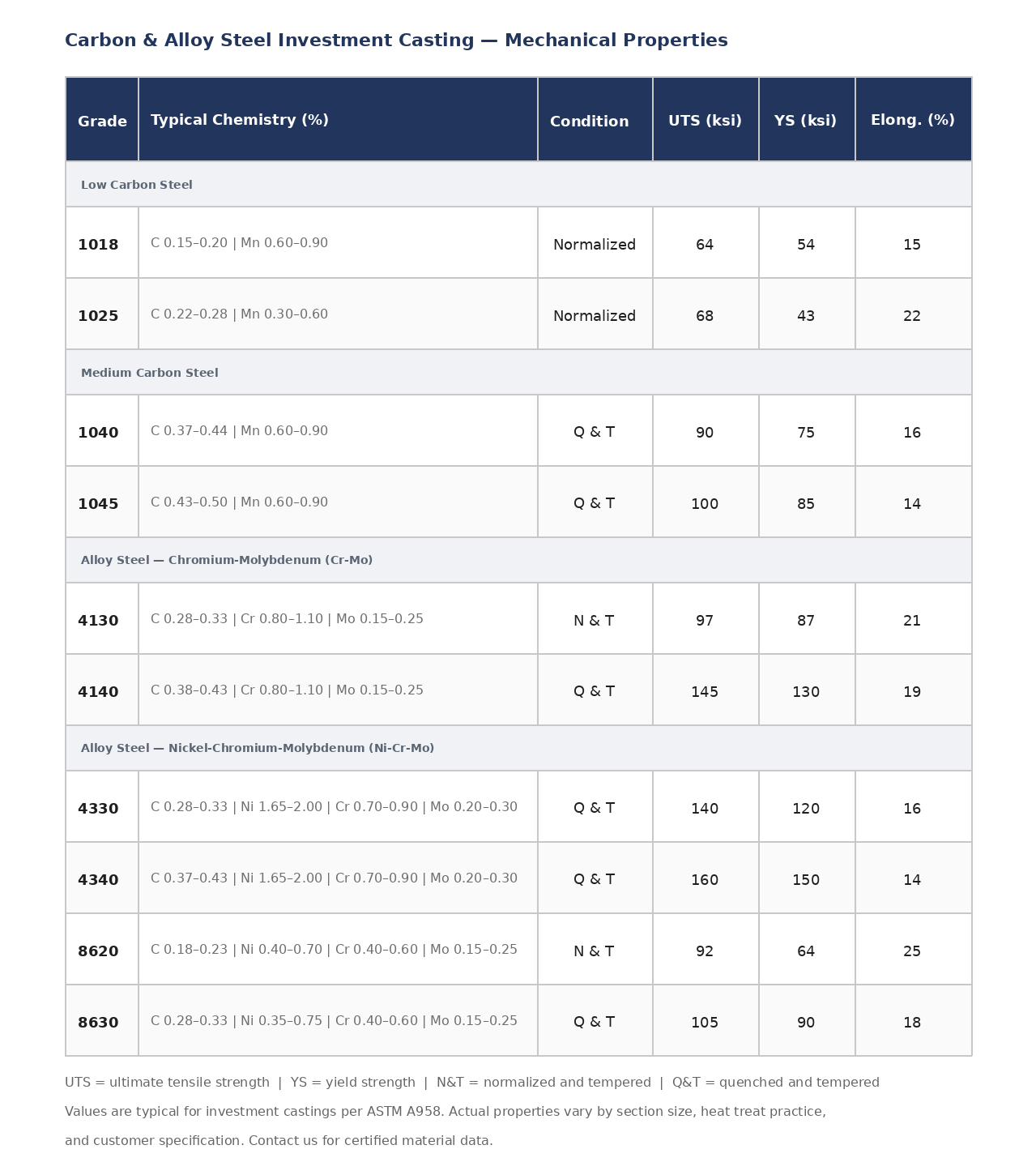
Low alloy steels are a versatile family of materials that combine the fundamental properties of carbon steel with small additions of alloying elements — primarily chromium, molybdenum, nickel, or combinations of all three — to significantly enhance mechanical performance. These alloying elements improve hardenability, allowing the material to develop high strength and toughness throughout the cross-section of a casting when heat treated. Chromium-molybdenum grades such as 4130 and 4140 are widely specified for their excellent strength-to-weight ratio, good weldability relative to higher carbon grades, and reliable performance under fatigue and impact loading. Nickel-chromium-molybdenum grades such as 4330 and 4340 offer even greater hardenability and toughness, making them the preferred choice for the most demanding structural and high-stress applications in aerospace and defense. The 8620 and 8630 grades are commonly selected where a combination of a tough, ductile core and a hard wear-resistant surface is needed, achieved through case hardening processes such as carburizing.
Choosing the Right Alloy for Your Application
Below is a chart highlighting the typical mechanical properties that can be acheived for low carbon, mid carbon and alloy steels.
Contact Us to Learn More About Our Investment Casting Process
Contact us today to learn more about investment casting carbon and alloy steel parts.
- Aluminum Alloys
- Carbon & Low Alloy Steels
- Cobalt Alloys
- Copper-Base Alloys
- Nickel-Base Alloys
- Stainless Steel Alloys
- Tool Steel Alloys
AS9100 Registered Aerospace Quality System. NADCAP approved for Nondestructive Testing, Welding, Heat Treating and Hardness Testing