Cobalt-Base Alloys for Investment Casting
Cobalt-base alloys are a family of superalloys renowned for their exceptional performance in the most demanding operating environments. These alloys typically contain controlled amounts of chromium, tungsten, molybdenum, nickel, and carbon to achieve excellent wear resistance, oxidation and corrosion resistance, and mechanical strength at elevated temperatures. Unlike most other alloy families, cobalt-base alloys retain their hardness and strength at temperatures that would cause other metals to soften — making them indispensable in aerospace, gas turbine, and oil and gas applications where no substitute exists.
Cobalt Alloy Types
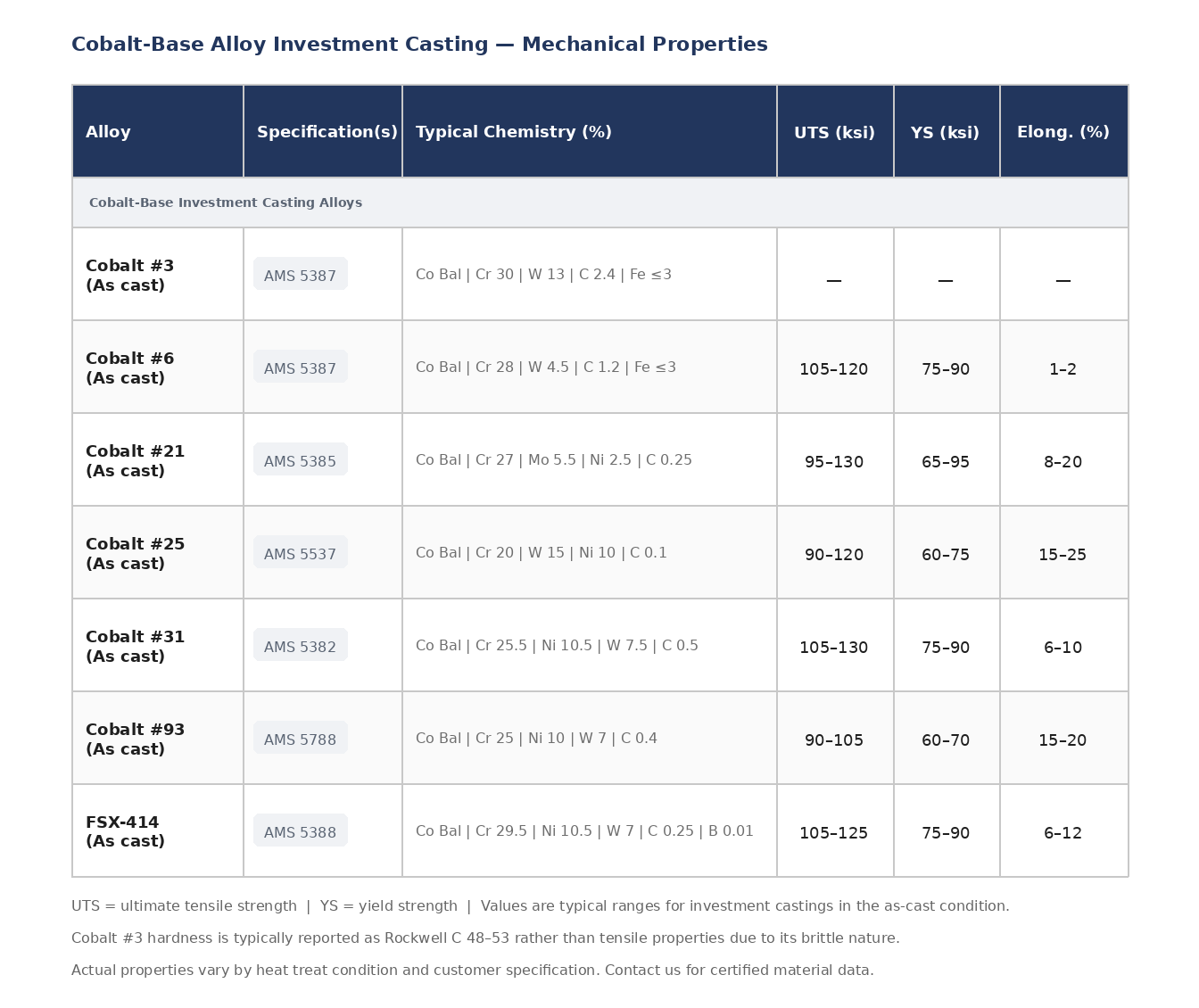
Wear-Resistant Grades (Co-Cr-W) These alloys rely on high carbon and tungsten content to form hard carbides that resist abrasion, erosion, and galling. Cobalt #3 and Cobalt #6 are the primary representatives of this family. Cobalt #3 has the highest carbon content of the group, making it the hardest and most abrasion-resistant, but with lower toughness. Cobalt #6 offers a broader balance of wear resistance and toughness and is one of the most widely used cobalt alloys across industry.
High-Temperature Superalloy Grades (Co-Cr-Ni-W) These alloys are formulated for structural performance at elevated temperatures, with lower carbon content and higher nickel additions to improve ductility and thermal fatigue resistance. Cobalt #21, #25, #31, #93, and FSX-414 belong to this group and are the grades most commonly specified for aerospace and gas turbine applications.
Alloy Descriptions
Cobalt #3 is a high-carbon, high-chromium-tungsten alloy offering the highest hardness and abrasion resistance of the group. It is best suited for applications involving severe sliding wear and erosion, such as valve seats and wear pads, where impact loading is minimal.
Cobalt #6 is the most widely used cobalt alloy in industry. It provides an excellent balance of wear resistance, corrosion resistance, and toughness, making it suitable for a broad range of valve, pump, and fluid handling components in oil and gas and petrochemical service.
Cobalt #21 offers exceptional resistance to thermal and mechanical shock and good corrosion resistance in a range of environments. It is widely used for valve trim, pump components, and wear-resistant fittings in high-temperature and corrosive service.
Cobalt #25 (L-605 / Haynes 25) is a high-strength wrought and cast superalloy with outstanding oxidation resistance to 2000°F. It is a primary aerospace alloy used for turbine blades, combustion liners, and high-temperature structural components.
Cobalt #31 provides high tensile strength and excellent creep resistance at elevated temperatures, making it well suited for gas turbine nozzles, vanes, and other hot section components subject to sustained high-temperature loading.
Cobalt #93 is valued for its exceptional durability and corrosion resistance in demanding long-service applications. Due to its exceptional durability and corrosion resistance, Cobalt #93 is ideal for demanding applications where longevity is crucial.
FSX-414 is a cobalt-chromium-tungsten superalloy developed specifically for gas turbine nozzle applications. FSX-414 contains 28.5–30.5% chromium, 9.5–11.5% nickel, and 6.5–7.5% tungsten, with cobalt as the balance providing outstanding hot corrosion resistance, thermal fatigue resistance, and high-temperature strength. It is one of the most widely cast cobalt superalloys in the aerospace industry.
Contact Us to Learn More About Our Investment Casting Process
Contact us today to learn more about investment casting cobalt-base alloys.
- Aluminum Alloys
- Carbon & Low Alloy Steels
- Cobalt Alloys
- Copper-Base Alloys
- Nickel-Base Alloys
- Stainless Steel Alloys
- Tool Steel Alloys

AS9100 Registered Aerospace Quality System. NADCAP approved for Nondestructive Testing, Welding, Heat Treating and Hardness Testing