Heat Treating & Hardness Testing
Heat treatment is one of the most critical post-casting operations in the investment casting process. By subjecting castings to controlled heating and cooling cycles, heat treatment develops the mechanical properties, microstructural characteristics, and corrosion resistance that the alloy is capable of delivering. Without proper heat treatment, even the most precisely cast component will not achieve the strength, hardness, ductility, or corrosion resistance required for its intended application.
NADCAP Accredited Heat Treatment & Hardness Testing for Investment Castings
By managing special process operations like heat treatment in-house, Engineered Precision Casting Company can avoid the production delays associated with transit and shared queue times, saving our customers time and money.
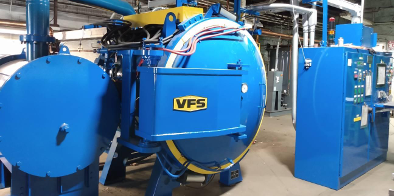
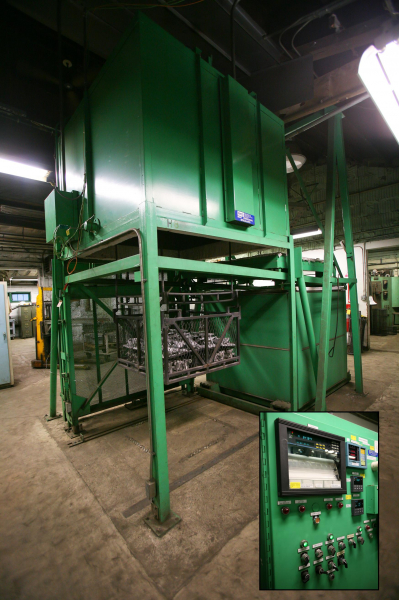
Our gas-quenched vacuum furnaces for heating steel castings and drop-bottom aluminum investment casting furnaces are surveyed regularly under strict accordance with the AMS-2750 Pyrometry requirements. Our part-specific instructions, tight process controls, preventive maintenance, qualified personnel, and routine compliance audits also ensure that your aerospace investment cast parts are processed in strict accordance with all contractual requirements.
We are NADCAP accredited for the following heat treating operations:
Heat Treatment of Steel Investment Castings
Steel investment castings — including carbon steel, alloy steel, stainless steel, tool steel, and precipitation hardening grades — may require one or more heat treatment operations depending on the alloy and the mechanical properties required. The following describes the primary heat treatment processes applied to steel investment castings.
Homogenization
Homogenization is a high-temperature heat treatment applied to steel castings to reduce chemical segregation and compositional variation that can develop during solidification. Homogenization is performed by heating the casting to a temperature near — but below — the solidus temperature of the alloy and holding it there for an extended period. At these elevated temperatures, solid-state diffusion redistributes alloying elements more uniformly throughout the microstructure, reducing segregation and improving compositional homogeneity. The result is a more uniform microstructure that responds more consistently to subsequent solution treatment and aging operations.
Solution Heat Treatment
Solution heat treatment is applied to austenitic stainless steels, precipitation hardening stainless steels, and certain other alloy systems to dissolve precipitates and second-phase particles that formed during solidification and cooling, producing a homogeneous single-phase microstructure. The casting is heated to a temperature at which the alloying elements are fully soluble in the base matrix — the solution treatment temperature — and held there for a sufficient time to allow complete dissolution. It is then rapidly quenched to room temperature to retain the dissolved elements in supersaturated solid solution, preventing reprecipitation during cooling.
Aging
Aging — also referred to as precipitation hardening or age hardening — is applied to precipitation hardening stainless steels after solution treatment to develop high strength and hardness through the controlled precipitation of fine, uniformly dispersed second-phase particles within the alloy matrix. The casting is reheated to a temperature significantly below the solution treatment temperature and held for a specified time, during which the supersaturated alloying elements precipitate as fine particles that impede dislocation movement and dramatically increase strength.
Normalizing
Normalizing is a heat treatment applied to carbon steel and low-alloy steel investment castings to refine the as-cast grain structure, relieve residual stresses, and improve mechanical properties and machinability. The casting is heated to a temperature above the upper critical temperature — into the fully austenitic region — and then air cooled. The relatively rapid air cooling produces a finer, more uniform microstructure than the slow cooling that occurs during solidification in the ceramic mold, resulting in improved strength, toughness, and dimensional stability. Normalizing is frequently specified as the first step in a multi-stage heat treatment sequence — for example, normalizing followed by tempering, or normalizing followed by quench and tempering.
Hardening
Hardening is applied to martensitic stainless steels, carbon steels, alloy steels, and tool steels to develop high hardness and strength through the formation of martensite — a hard, metastable microstructural phase produced by rapid cooling from the austenitic temperature range. The casting is heated to the austenitizing temperature — where the steel transforms fully to austenite — and then rapidly quenched in oil, water, polymer solution, or forced air, depending on the alloy and the section thickness of the casting.
As-quenched martensitic microstructures are extremely hard but also brittle and highly stressed, making them unsuitable for most engineering applications without subsequent tempering. Hardening is therefore almost always followed immediately by tempering to develop the combination of strength, hardness, and toughness required for the application.
Tempering
Tempering is performed immediately after hardening to reduce the brittleness of the as-quenched martensitic microstructure and develop the combination of strength, hardness, and toughness required for service. The hardened casting is reheated to a temperature well below the lower critical temperature — typically in the range of 300°F to 1200°F depending on the alloy and the required properties — and held for a specified time before air cooling.
Heat Treatment of Aluminum Investment Castings
Aluminum investment castings are heat treated to develop the mechanical properties specified for their application. Unlike steel heat treatments, which rely primarily on martensitic transformation, aluminum heat treatments develop strength through a combination of solid solution strengthening and precipitation hardening. The most common heat treatment conditions for aluminum investment castings are T4, T6, T61, and T51, each producing a distinct combination of strength, ductility, and dimensional stability.
T4 — Solution Heat Treatment
The T4 condition is produced by solution heat treating the casting at elevated temperature to dissolve alloying elements — primarily silicon, magnesium, and copper — into solid solution, followed by a water quench to retain the dissolved elements in supersaturated solid solution. The T4 condition is specified for aluminum investment castings where good formability, moderate strength, and the ability to be subsequently cold worked or formed after heat treatment are required. T4 treated castings that are subsequently artificially aged are reclassified to the T6 condition.
T6 — Solution Heat Treatment and Artificial Aging
The T6 condition is the most widely specified heat treatment for aluminum investment castings and is the standard condition for A356, C355, A357, and F357 alloy castings for aerospace, defense, and structural applications. It consists of solution heat treatment at elevated temperature followed by a water quench, and then artificial aging at a controlled elevated temperature for a specified time. The T6 condition delivers the highest strength of the standard aluminum heat treatment conditions, with typical ultimate tensile strengths of 33–41 ksi depending on the alloy.
T61 — Solution Heat Treatment and Controlled Artificial Aging
The T61 condition is a variation of the T6 treatment. The T61 temper is an over-aged state, which has higher conductivity than T6 but slightly lower mechanical properties. This state is commonly used in applications that require higher conductivity but lower strength.
T51 — Stress Relief
T51 refers to a condition in which the casting is artificially aged directly from the as-cast or thermally stabilized condition, without the full solution treatment and quench cycle of the T6 process. The T51 condition develops lower strength than T6 or T61 but offers significantly better dimensional stability and freedom from residual stress, making it suitable for castings used in precision assemblies where dimensional consistency is more critical than maximum mechanical strength.
Contact Us with Your Questions About Heat Treating and Hardness Testing
Engineered Precision Casting Company performs all heat treating and hardness testing in house to save you time and money. Contact our casting foundry to learn more about our investment casting capabilities and to discuss heat treatment options for your casting project.
- Heat Treating & Hardness Testing
- Non-Destructive Testing
- Welding
- CAD Modeling & Engineering Services
- HIPping (Hot Isostatic Pressing)

AS9100 Registered Aerospace Quality System. NADCAP approved for Nondestructive Testing, Welding, Heat Treating and Hardness Testing