Stainless Steel Casting Alloys
Stainless steel investment castings are widely specified in industries where strength, corrosion resistance, and precision are non-negotiable. In aerospace and defense, they are used for structural brackets, housings, and valve bodies that must perform reliably under extreme temperatures and mechanical loads. Marine applications leverage stainless steel's resistance to saltwater corrosion for pumps, valves, and hardware used in offshore and shipboard environments. In the medical field, stainless steel's biocompatibility and resistance to sterilization processes make it a preferred material for surgical instruments and diagnostic equipment. Across industrial applications, stainless steel castings are found in pumps, fittings, and mechanical components that must withstand harsh chemicals, high pressures, and demanding operating conditions.
Stainless Steel Alloy Types
There are numerous grades of stainless steel, each with a distinct chemical composition that determines its mechanical properties, corrosion resistance and magnetic properties.
Austenitic Stainless Steel
Austenitic stainless steels are the most widely used family of stainless steel, accounting for the majority of stainless castings produced globally. They are characterized by a face-centered cubic (FCC) crystal structure, which is stabilized by nickel additions in combination with chromium. This microstructure gives austenitic grades their defining properties: excellent corrosion resistance, high ductility, good weldability, and the ability to perform reliably across a wide temperature range from cryogenic conditions to elevated service temperatures.
Austenitic grades are non-magnetic in the annealed condition and cannot be hardened by heat treatment — their strength can only be increased through cold working. The 300 series is the primary family of austenitic investment casting alloys, with grades such as 304, 316, 316-L, 310, and 347 representing the most commonly used options. Within the 300 series, the addition of molybdenum in 316 and 316-L significantly improves resistance to pitting and crevice corrosion, making these grades the preferred choice for marine, chemical processing, and food and dairy environments. Low-carbon variants such as 304-L and 316-L are specified where resistance to sensitization — the precipitation of chromium carbides at grain boundaries during welding — is required. Nitronic 50 is a higher-strength austenitic grade offering improved resistance to wear and pitting compared to standard 316, and is commonly used for shafts, fasteners, and marine hardware.
Martensitic Stainless Steel
Martensitic stainless steels are chromium alloys with higher carbon content than austenitic grades, giving them a body-centered tetragonal crystal structure that forms when the steel is rapidly cooled from elevated temperatures. Unlike austenitic grades, martensitic stainless steels are magnetic and can be significantly hardened and strengthened through quench and tempering heat treatment, making them the preferred choice when high strength and hardness are required alongside moderate corrosion resistance.
The trade-off for this hardenability is a reduction in corrosion resistance and weldability compared to austenitic grades. Martensitic stainless steels perform well in mildly corrosive environments and in applications involving wear, abrasion, or high mechanical loads — but they are generally not suitable for highly corrosive environments such as seawater or acidic media without additional surface treatment. The 400 series represents the primary family of martensitic investment casting alloys, with grades such as 410, 416, 420C, 431, and 440C covering a range of carbon contents and strength levels.
Precipitation Hardening (PH) Stainless Steel
Precipitation hardening stainless steels represent a specialized family that bridges the gap between austenitic and martensitic grades. They are alloyed with elements such as copper, aluminum, or niobium that form fine precipitates within the matrix during a controlled aging heat treatment, dramatically increasing strength and hardness without the severe quenching required for martensitic grades. This aging process occurs at relatively low temperatures, resulting in minimal distortion of finished or near-finished castings — a significant advantage in precision investment casting applications where dimensional stability is critical.
PH grades are magnetic and offer a combination of high strength, good corrosion resistance, and reasonable weldability that neither purely austenitic nor purely martensitic grades can match. They are widely specified in aerospace, defense, and petrochemical applications where components must meet stringent strength requirements while maintaining adequate corrosion resistance. The most commonly investment cast PH grades are 17-4 PH and 15-5 PH, both of which are martensitic PH grades that achieve tensile strengths significantly exceeding those of standard austenitic or martensitic stainless steels depending on the aging condition selected. CD4MCu (25-5) is a duplex PH grade offering exceptionally high strength and outstanding corrosion resistance, and is frequently specified for the most demanding chemical and petrochemical service.
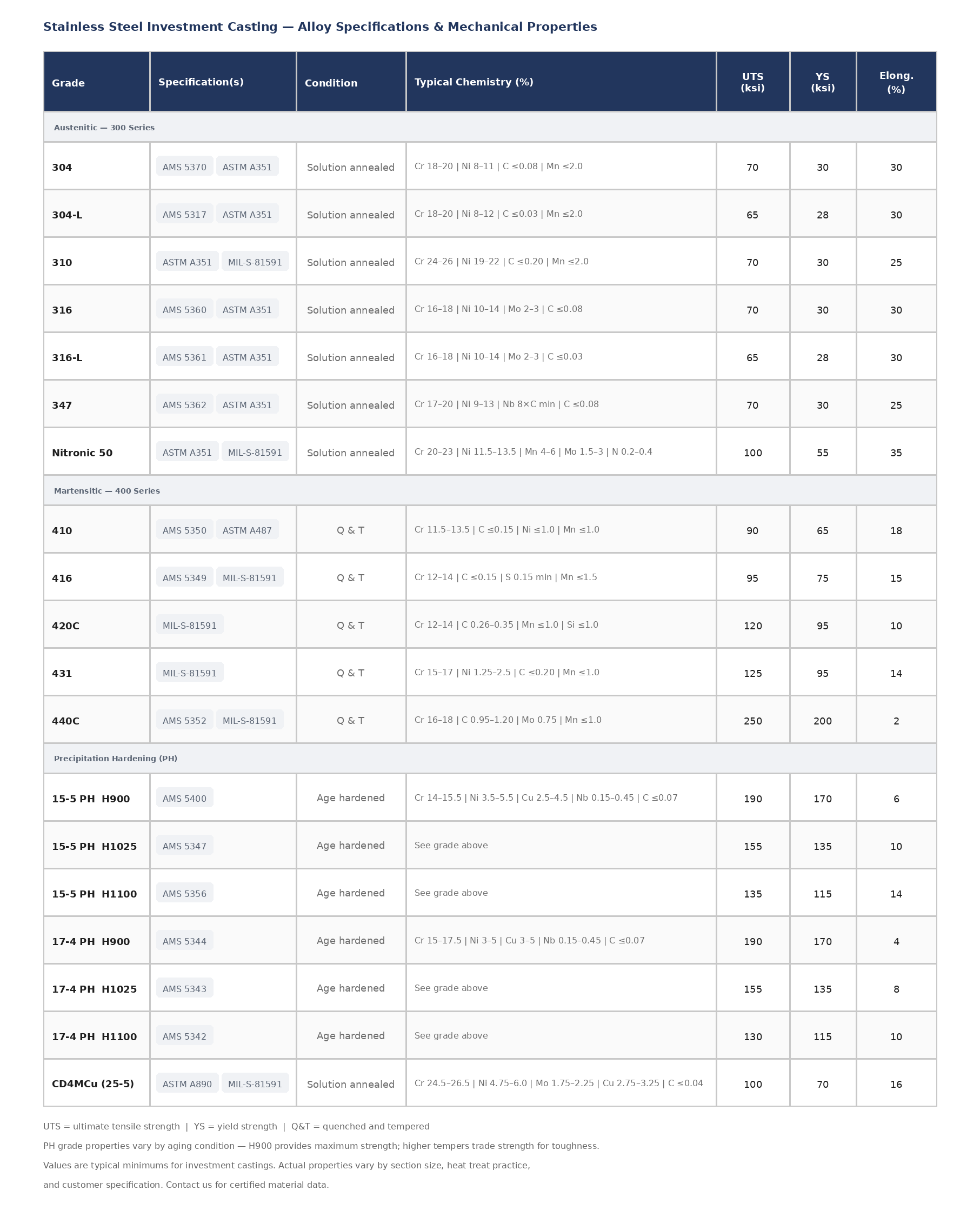
Below is a list of common stainless steel alloys we cast:
Ready to Start Your Stainless Steel Casting Project?
We cast a full range of stainless steel alloys and offer in-house services to take your project from design through finished part. Contact us to discuss your requirements or request a quote for your stainless steel investment casting.
- Aluminum Alloys
- Carbon & Low Alloy Steels
- Cobalt Alloys
- Copper-Base Alloys
- Nickel-Base Alloys
- Stainless Steel Alloys
- Tool Steel Alloys

AS9100 Registered Aerospace Quality System. NADCAP approved for Nondestructive Testing, Welding, Heat Treating and Hardness Testing